

admin.spr@ebor.academy | 01482 811 499

Inclusion in the Curriculum

Inclusion in the curriculum: same intent, adapted implementation

At Sproatley C of E Primary Academy, we strive to make our curriculum accessible to all children. We believe that an inclusive education means supporting all pupils to learn, contribute and participate in all aspects of school life so that they can achieve to the best of their abilities. Our curriculum includes not only the formal requirements of the National Curriculum, but also a range of additional opportunities to enrich the experiences of our children. We recognise that all children have different needs and we make reasonable adaptations to enable children with SEND to access a full curriculum. We seek advice, resources, equipment and training in order to provide high quality experiences for our children and to remove barriers to learning. In this document are some strategies that can be implemented by class teachers to address the needs of pupils with SEN. This may involve using strategies suggested by the Education Endowment Foundations’ ‘5 a day’ approach:
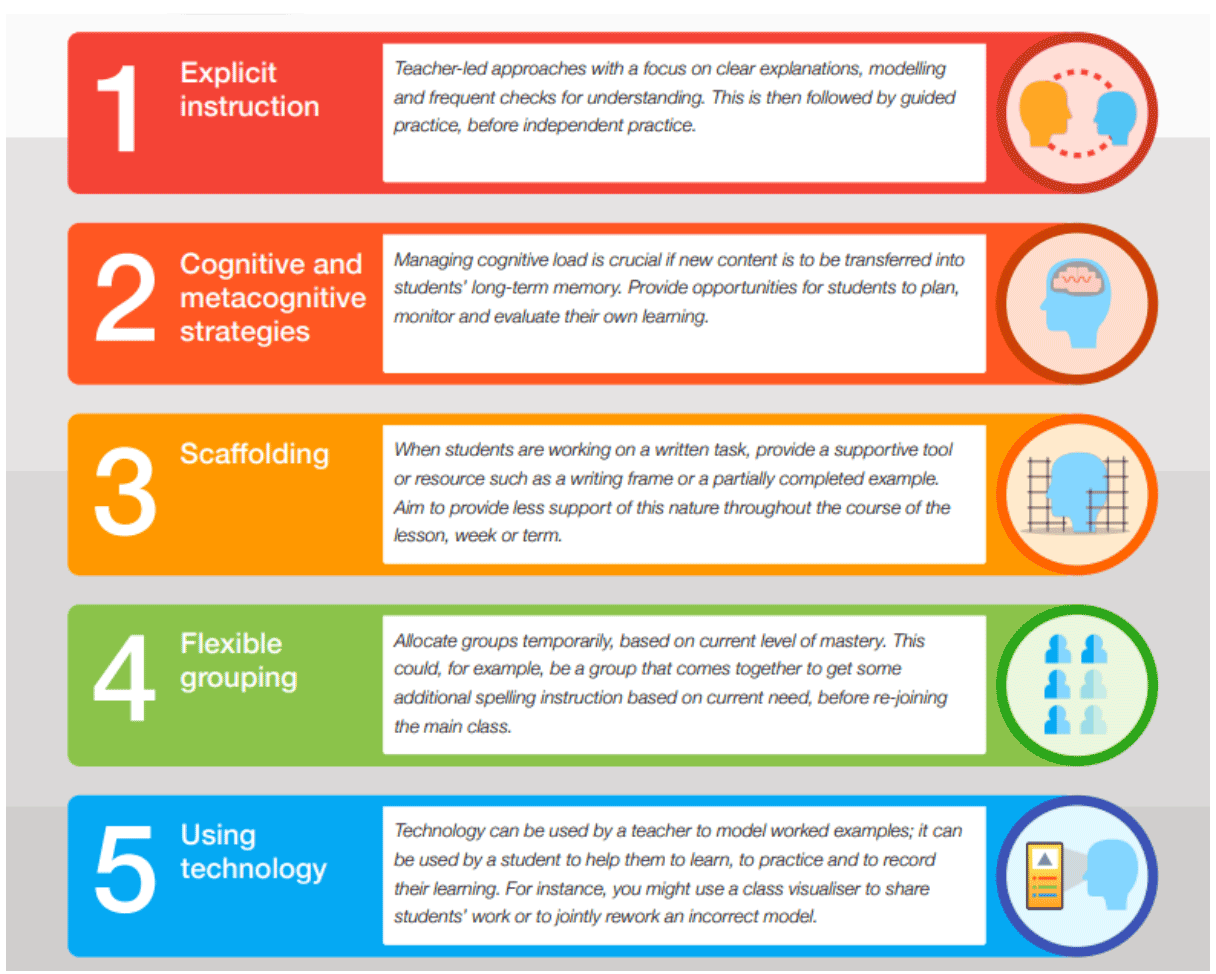
We use a ‘Quality First’ teaching approach. Some of the adaptations to our curriculum are as follows (These are suggestions of what may be implemented, but teachers will amend according to learners needs):

MATHS

  • Use of stem sentences to develop understanding of mathematical concepts
  • Conceptual language developed through visuals, use of the working wall and pre teach
  • Flexible, targeted small groups to work with the most qualified adults
  • Key fluency and basic skills practised daily
  • Promoting independence with accessing and using concrete manipulatives
  • Encouraging a resilient learners and embracing mistakes alongside celebrating success
  • Use of alternative technology for recording or staff may scribe for children to ensure a child’s explanations and articulation is not limited by writing competence
  • Teachers plan for rehearsal and recollection of learning in each session, to practise recalling what they have learnt.
  • Preteaching of conceptional language or word banks with pictures are supplied and present in class to assist learners with subject specific language

ENGLISH

  • Technology used to support learning: Read & Write, voice typing, listening, voice recorders for sentence rehearsal
  • Sentence stems to support sentence construction
  • Books carefully matched to phonics level with regular assessments
  • Consistent resources used i.e. sound mats, sound buttons, terminology, pen grips, spelling mats, word banks (pictorial if needed) across all subject areas
  • Planned opportunities for mark making and the development of fine motor control
  • Vocabulary rich environment. Teachers plan for cross-curricular knowledge building to consolidate and broaden experience, vocabulary and comprehension
  • Learning is interactive. Use of talk – modelled, shared and peer – helps to stimulate vocabulary and understanding.
  • Use of alternative technology for recording or staff may scribe for children to ensure a child’s explanations and articulation is not limited by writing competence
  • Teachers plan for rehearsal and recollection of learning in each session, to practise recalling what they have learnt.
  • Preteaching of conceptional language or word banks with pictures are supplied and present in class to assist learners with subject specific language

HISTORY

  • Pictorial resources if needed with  subject specific and conceptual language, which may be pre-taught in some cases
  • History vocabulary taught explicitly and linked to visual prompts where possible e.g. chronology and sources and may be pre taught to some learners
  • Use of alternative technology for recording or staff may scribe for children to ensure a child’s explanations and articulation is not limited by writing competence
  • Active learning techniques used
  • Open ended tasks to present ideas e.g. audio/visual/spoken etc not always written
  • Creative links to the topic for our most complex SEND pupils
  • Teachers plan for rehearsal and recollection of learning in each session, to practise recalling what they have learnt.

GEOGRAPHY

  • Pictorial resources if needed with  subject specific and conceptual language, which may be pre-taught in some cases
  • Geographical vocabulary taught explicitly and linked to visual prompts where possible this may be pre taught to some learners
  • Use of alternative technology for recording or staff may scribe for children to ensure a child’s explanations and articulation is not limited by writing competence
  • Active learning techniques used
  • Open ended tasks to present ideas e.g. audio/visual/spoken etc not always written
  • Creative links to the topic for our most complex SEND pupils
  • Teachers plan for rehearsal and recollection of learning in each session, to practise recalling what they have learnt.

PE and Outdoor Learning

  • Teachers use learners’ preferred communication method. They may use key words or signs to break down lengthy instructions/rules
  • Technology used to show games and activities
  • Adapted tasks or skills to make sports and games accessible.
  • Mini games with smaller groups with supported adults if needed
  • Consideration of the environment to ensure all learners can access activities, reducing background noise and ensuring those with hearing impairments are close to the teacher

ART

  • Open exploration of art media and open explorations of technique
  • Small group teaching opportunities to support and provide additional learning opportunities for learners working towards a planned objectives
  • Enhance use of vocabulary
  • Visual stimulus given to scaffold ideas
  • Inclusion of under-represented groups, including those with disabilities, to provide a role models to learners
  • Sketchbook annotations and evaluations
    approached in a different way (adults scribe in sketchbooks, voice recordings/video recordings)
  • Teachers plan for rehearsal and recollation of learning in each session, to practise recalling what they have learnt.
  • Modelling by an adult, support from peers or adults
  • Preteaching of conceptional language or word banks with pictures are supplied and present in class to assist learners with subject specific language

DT

  • Small group teaching opportunities to support and provide additional learning opportunities for learners working towards a planned objective
  • Preteaching of conceptional language or word banks with pictures are supplied and present in class to assist learners with subject specific language
  • Use of a model, support of an adult or peer
  • Teachers use learners’ preferred communication method. They may use key words or signs to break down lengthy instructions
  • Multi-sensory approaches including ICT
  • Using a range of methods to communicate
  • Pace adapted to suit individual needs
  • Personally motivating tasks
  • Assistance using tools and measuring to ensure assessment focus considers design and ideas as much as practical execution

RE

  • Maintaining an inclusive learning environment – every individual matters and should be valued, respected and heard
  • Multi-sensory approaches – children access RE in a variety of ways, including handling religious artefacts, drama, music, listening to guest speakers, visiting places of worship, working on chromebooks, voice recording ideas and expressing views, picture cards, drawing, painting, crafting and modelling
  • Alternative recording or adults can scribe where necessary to support learners to ensure a child’s explanations and articulation is not limited by writing competence
  • Group discussion and work helps manage peer relationships and build respect and understanding on others’ views
  • Provide learners with targeted resources to support their learning and understanding such as concept cartoons, timelines, prompts and visual aids
  • Formative assessment/memory and consolidation – as well as learning in a variety of ways, children have different opportunities to showcase their learning in a range of ways through art, discussion and written responses.
  • Preteaching of conceptional language or word banks with pictures are supplied and present in class to assist learners with subject specific language
  • Use stories to facilitate learning by presenting information in a narrative format, making it easier for learners to understand and remember complex concepts.

PSHE

  • Maintaining an inclusive learning environment – every individual matters and should be valued, respected and heard
  • Alternative recording or adults can scribe where necessary to support learners to ensure a child’s explanations and articulation is not limited by writing competence
  • Use stories to facilitate learning by presenting information in a narrative format, making it easier for learners to understand and remember complex concepts.
  • Small group teaching opportunities to support and provide additional learning opportunities for learners working towards a planned objectives
  • Open ended tasks
  • Preteaching of conceptional language or word banks with pictures are supplied and present in class to assist learners with subject specific language
  • Teachers plan for rehearsal and recollection of learning in each session, to practise recalling what they have learnt.

SCIENCE

  • Spiral curriculum – revisiting of topics
  • Small group teaching opportunities to support and provide additional learning opportunities for learners working towards a planned objectives
  • Hands-on approach to science learning
  • Real-life settings used where possible to provide concrete context (particularly in apply tasks)
  • Preteaching of conceptional language or word banks with pictures are supplied and present in class to assist learners with subject specific language
  • Teachers plan for rehearsal and recollection of learning in each session, to practise recalling what they have learnt.
  • Use of technology to assist with recording
  • Provide learners with targeted resources to support their learning and understanding such as concept cartoons, timelines, prompts and visual aids
  • Alternative recording or adults can scribe where necessary to support learners to ensure a child’s explanations and articulation is not limited by writing competence
  • Inclusion of under-represented groups , including those with disabilities, to provide a role models

MUSIC

  • We offer a spiral curriculum where everything is reinforced ongoing.
  • Use small group teaching opportunities to dedicate more time and support to provide additional learning opportunities to learners working toward a planned objective
  • Multi-sensory teaching is used in all music lessons, with seeing, hearing and doing activities rather than being text/listening heavy.
  • Whole school Music worships are open to all learners
  • Learning environment carefully considered – lighting, unneeded distraction, consideration of noise, physical contact with instrument for hearing impairment
  • Have a safe place to withdraw to, arranged movement breaks or ‘timeout’ away from learning environment

COMPUTING

  • Concepts are introduced ‘unplugged’, in relative and familiar contexts
  • Flexible grouping that considers each individuals strengths and needs e.g. pairs/small groups/whole class
  • Variety of ways to present ideas e.g. verbal/voice recording, simple drawing/labelling/writing,computer programmes and websites
  • Chromebook use is taught and well-established throughout the whole curriculum to support the needs of learners, as well as embedding other types of technology as a strategy to support all learners
  • Accessibility tools built into chromebooks used to support learning across all areas
  • Teachers plan for rehearsal and recollection of learning in each session, to practise recalling what they have learnt.

MFL

  • Curriculum recaps and builds on previous knowledge in small steps.
  • Sentence builders and knowledge organisers support learning, with simplified scaffolds for SEND where needed.
  • Active lessons to support learning of vocabulary and memory eg use of pictures, actions, music and memory association.
  • Small group teaching opportunities to support and provide additional learning opportunities for learners working towards a planned objectives
  • Use of IT, particularly sound files, games,
  • Teachers plan for rehearsal and recollection of learning in each session, to practise recalling what they have learnt.
  • Alternative recording or adults can scribe where necessary to support learners to ensure a child’s explanations and articulation is not limited by writing competence